Commercial Interior Design Trends to Watch in 2026
As a woman-owned interior design firm specializing in commercial environments across Maryland, DC, Virginia, and Pennsylvania, we at L’IMAGE Design Studio are constantly tracking where design is headed — not just what looks good now, but what will matter in the workplace of the near future. With 2026 just around the corner, the commercial interior design landscape is evolving rapidly under the influence of technology, wellbeing, sustainability, and shifting work habits. Here are the key trends we believe will define commercial interiors in 2026 — and how we’re already integrating them into our projects.
- Human-Centric & Well-being-First Environments
In 2026, the design of commercial spaces goes beyond aesthetics — it’s about how spaces support the people inside them. Trends point to environments where lighting, acoustics, air quality, layout, and materials all work in concert to support focus, health, and meaning.
- Look for tunable-white lighting systems that mimic natural daylight and support circadian rhythms.
- Acoustic comfort is no longer an afterthought: quiet zones, phone pods, and sound-absorbing finishes help balance collaboration and concentration.
- Well-being zones (think indoor garden lounges, restful breakout pods, informal social hubs) are becoming standard, not luxury.
Our take at L’IMAGE: When we design an office layout, we begin by mapping how different types of users move through the space in a day — from focused work to spontaneous conversation to rest. Then we align finishes, lighting, and furniture to those rhythms.
- Flexible / Activity-Based Layouts & Tech-Enabled Spaces
Gone are the days of rigid rows of desks. Commercial design in 2026 emphasizes adaptability, sensor-driven spaces, and layouts that evolve with changing needs.
- Modular furniture and moveable partitions allow a single floorplate to shift between individual focus work, collaborative zones, and social spaces with minimal disruption.
- Smart infrastructure: occupancy sensors, real-time usage analytics, and adaptive lighting/HVAC systems help optimize comfort, energy use, and space planning.
- Activity-Based Working (ABW) is now mainstream: design zones that reflect how people actually work, rather than forcing them into one way of working.
Our take at L’IMAGE: When working on a corporate or multi-tenant commercial project, we build in furniture and partitions that can be re-configured easily (rather than demolished and rebuilt).
- Sustainability + Circular Design as the Standard
In 2026, sustainability is not optional — it’s embedded. Commercial interiors are being shaped by circular design principles, material honesty, and local sourcing.
- Use of reclaimed, recycled, or up-cycled materials; minimizing composites and designing for disassembly.
- Local sourcing and transparency: clients increasingly want to know the origin of materials, their treatment, and end-of-life path.
- Designing for longevity — furniture that can be re-upholstered, finishes that age gracefully, rather than short-term trends.
Our take at L’IMAGE: We source from vendors that provide material coupons, life-cycle data, and refurbish options. We also design millwork with demountable connections to facilitate future reuse or repurposing. It’s part design-forward; part responsible-forward.
- Rich Materials, Curves, Color & Warm Minimalism
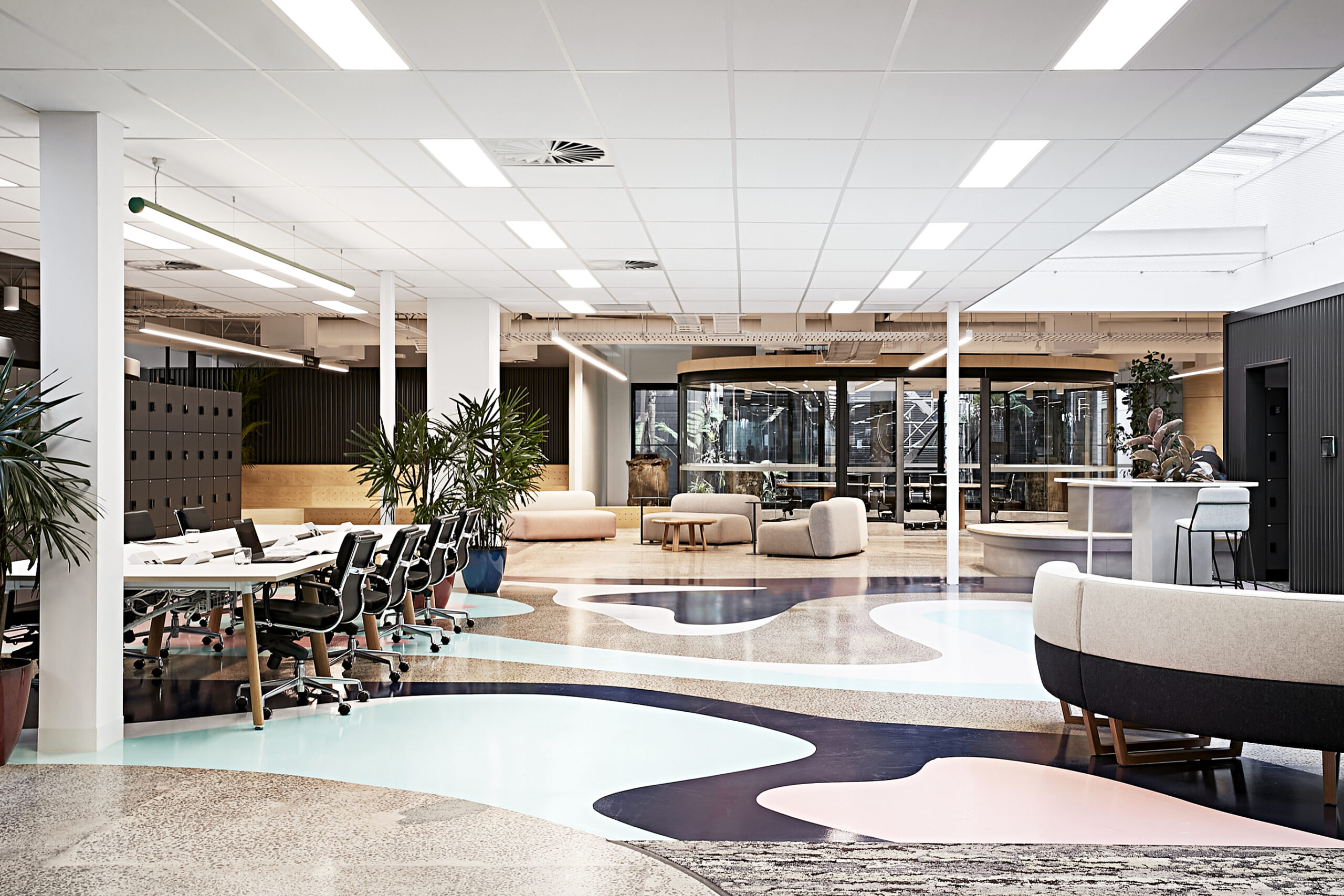
Minimalism remains influential, but “cold grey and white” is on the way out. For commercial interiors in 2026, design is embracing warmth, texture, layered color, and organic forms.
- Expect overheads (ceilings, soffits) to become design features — bold color, statement lighting, and layered geometry.
- Curved furniture, organic lines, irregular shapes that soften the commercial environment and reduce visual stiffness.
- Warm minimalism: pared-back layouts but richer finishes — woods, tactile fabrics, subtle variations in tone rather than stark whites.
Our take at L’IMAGE: In lobby and reception zones we’re specifying warm wood slats (walnut or caramel tones), curved benches or pods, and accent ceilings with deep color to create interest. We avoid “sterile modern” by mixing texture, warmth, and visual layering.
- Brand Experience + Human Storytelling
Finally, commercial interior design is increasingly about experience and storytelling. Spaces are designed not just to serve function, but to communicate culture, values, and identity.
- Experiential interiors combine tactile finishes, lighting narrative, acoustics, and even scent to craft an emotional engagement.
- Spaces that support multiple modes — not only work but event, social, rest — become part of brand storytelling.
- Interior architecture as a differentiator: for clients, the physical space becomes a strategic asset (talent attraction, brand message, productivity).
Our take at L’IMAGE: For every commercial project, we build a “brand-through-space” brief. We ask: What should people feel when they enter? What story do we want the space to tell? Then we design finishes, lighting zones, and social hubs to reinforce that message.
In Conclusion
2026 is shaping up to be a watershed moment in commercial interior design — where wellbeing, flexibility, sustainability, material richness, and brand-driven experience converge. At L’IMAGE Design Studio, we’re ready to help clients navigate this evolving landscape, turning these trends into thoughtful, functional, and beautiful spaces.
If you’re planning a commercial renovation, an office repositioning, or a new build environment, let’s talk about how we can embed these 2026-forward strategies into your project.
Ready to get started? Contact us, L’IMAGE Design Studio, Glenwood, MD — 410-489-0678 — or through our website, for a consultation on your next commercial interior design venture.